

Description
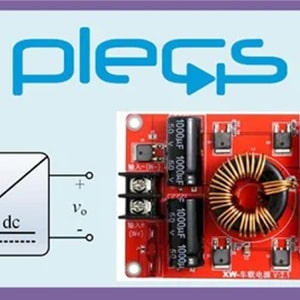
Mastering Power Electronics with Plecs Simulation: From Fundamentals to Advanced Applications
Course Requirements
-
Basic understanding of electrical circuits, including voltage sources, current sources, and passive components.
-
Fundamentals of power electronics.
-
No prior experience with Plecs is required; practical exercises will guide you step by step.
Course Description
Simulation is a cornerstone in modern power electronics. It allows engineers to experiment with complex converter topologies, optimize designs, and test different scenarios without the limitations of physical prototypes. Acting as a virtual laboratory, simulation empowers engineers to gain practical insights while saving time and resources.
Plecs is a powerful simulation software with a Simulink-like interface, enabling the design and visualization of various power converter topologies. This course provides hands-on experience with Plecs through practical exercises and real-world examples, making it perfect for both students and professionals in electrical, electronics, and computer engineering.
What You Will Learn
This comprehensive course is divided into the following modules:
Module 1: Introduction to Power Converters
-
Fundamentals of power electronics and power conversion
-
Key analysis tools: Fourier series, Total Harmonic Distortion (THD), Power Factor, Average & RMS Values, Periodic Steady-State Analysis
Module 2: Getting Started with Plecs
-
Installation and setup of Plexim Plecs
-
Building and simulating your first Plecs model
-
Editing block parameters and scope settings
-
Creating your first electrical circuits in Plecs, including:
-
Half-wave rectifier simulation
-
Using Plecs schematics and waveforms in reports
-
Exporting waveforms as CSV files and importing them into MATLAB
-
Fourier spectrum analysis, average and RMS calculations
-
Parameter tuning with the hold trace option
-
-
Optional: Modeling mechanical systems in Plecs
Module 3: Simulation Scripts in Plecs Standalone
-
Introduction to Octave console
-
Working with simulation scripts
-
Evaluating parameters, exporting, and importing CSV data
-
Controlling scope traces using scripts
Module 4: C Programming in Plecs (C-Script Block)
-
Introduction to the C-script block
-
Using parameters and multiplexed inputs
-
Enhancing simulations with custom C code
Module 5: AC-DC Converters
-
Overview and classification of AC-DC converters
-
Practical simulations:
-
Half-wave diode rectifier with resistive and inductive loads
-
Single-phase bridge rectifier
-
Controlled rectifiers with resistive load
-
Module 6: DC-DC Converters
-
Introduction to DC-DC buck converter and Pulse Width Modulation (PWM)
-
Designing a Buck converter in Plecs
-
Frequency response using impulse response analysis
-
Feedback controller design and system identification
-
Implementing digital control for Buck converters
Module 7: DC-AC Converters
-
Simulation of half-bridge and full-bridge inverters
-
Advanced topics:
-
Quasi-square wave, three-level inverter, phase-shift modulation
-
Sinusoidal PWM, bipolar and unipolar SPWM
-
Full-bridge inverter with series and parallel resonant networks
-
Gain characteristics curve analysis using scripts
-
Three-phase bridge inverter in 180° and 120° conduction modes
-
Module 8: TI C2000 Microcontroller Programming Using Plecs
-
Introduction to Texas Instruments C2000 MCU
-
GPIO programming: LED blink, input/output configuration
-
PWM using C2000 in external mode
-
Using DAC and ADC for offline simulation of power converters
-
Implementing digital control for Buck converters
Who This Course is For
-
Undergraduate and postgraduate students in Electrical, Electronics, and Computer Engineering
-
Professionals and engineers who want to master Plecs simulation for practical applications
-
Anyone interested in power electronics simulation, design, and control
Key Benefits
-
Gain hands-on experience with Plecs and real-world simulations
-
Understand complex converter topologies without physical prototypes
-
Learn to analyze and optimize power electronics systems
-
Enhance skills in digital control and microcontroller-based power conversion
Please Note: Files will be included in this purchase only Full Course Video & Course Resources. You will get cloud storage download link with life time download access.


Reviews
There are no reviews yet.